
Test the hypothesis before the agent builds it: a check against your customer calls
Coding agents build wrong beliefs fast. A 5-step check: write the hypothesis so it can fail, search calls for support and contradiction, score it.
A coding agent can turn a product idea into merged code before lunch. That’s great when the idea is right.
When it isn’t, you’ve shipped a wrong belief at machine speed. The code works. The tests pass. And nobody asked for it.
Building got cheap. Being wrong didn’t. This post is a short, repeatable check you can run before a hypothesis turns into a spec: write it so it can fail, search your customer calls for support and for contradiction, score it, and hand only the supported ones to the agent.
The bottleneck moved to deciding what to trust
”Building got cheap. Being wrong didn’t.”
A year ago a weak hypothesis cost you a sprint. Someone had to design it, build it and review it, and somewhere along the way a person usually asked “wait, who wanted this?”
Now the agent doesn’t ask. It builds exactly what the spec says. A wrong belief costs a day of merged code and then a quarter of confusion: support tickets, a feature nobody turns on and a roadmap meeting about why adoption is flat.
The tools are moving the same way. DefoAI’s Discovery agent now tells you when a belief is not supported and names the interview behind each answer. Figma’s Specs beta puts a human review of the implementation plan before the plan goes to Codex. One industry newsletter put it plainly last week: the bottleneck is moving from gathering evidence to deciding what to trust.
So the check has to happen before the spec. Here’s the one we use.
Step 1: write the hypothesis so it can fail
Most hypotheses are written to survive. “Customers want better reporting” can’t be wrong, so it can’t be tested.
Use 4 lines instead:
- 🎯 We believe a specific change (bulk export from the reports page)
- 👥 For whom a specific segment (CS leads at accounts over 200 seats)
- 📈 We will see a measurable result (fewer “can you send me a CSV” tickets within 30 days)
- 🎧 In calls we expect what customers would have said if it’s true (they ask for exports by name, they describe copying data into spreadsheets, they mention a weekly report to their boss)
The last line is the one teams skip. It turns a belief into something you can look for. If you can’t say what a customer would have said, you don’t have a hypothesis yet. You have a hunch.
Step 2: search your calls for support and for contradiction
This is where most “validation” goes wrong. Someone searches the call library for the feature name, finds 3 great quotes and pastes them into the spec.
That’s not a test. That’s a highlight reel.
Search for 3 things, in this order:
- ✅ Support: customers describing the problem in their own words, not just the feature name. “I copy it into a sheet every Monday” counts even if they never say “export”.
- ❌ Contradiction: customers in the same segment who describe the opposite (“we never look at reports, the dashboard is enough”) or who solved it another way.
- 🔇 Silence: the segment you named, talking about the area, and never raising it. Silence is evidence too.
Count accounts, not mentions. One champion who asks 5 times is 1 customer. And note when each call happened: a request from 9 months ago may already be solved, or may have churned.
A CPO told us the hard part isn’t hearing customers. It’s that when they brought call learnings to the team, they “didn’t have data to back it up”. That’s the gap this step closes.
Step 3: score it
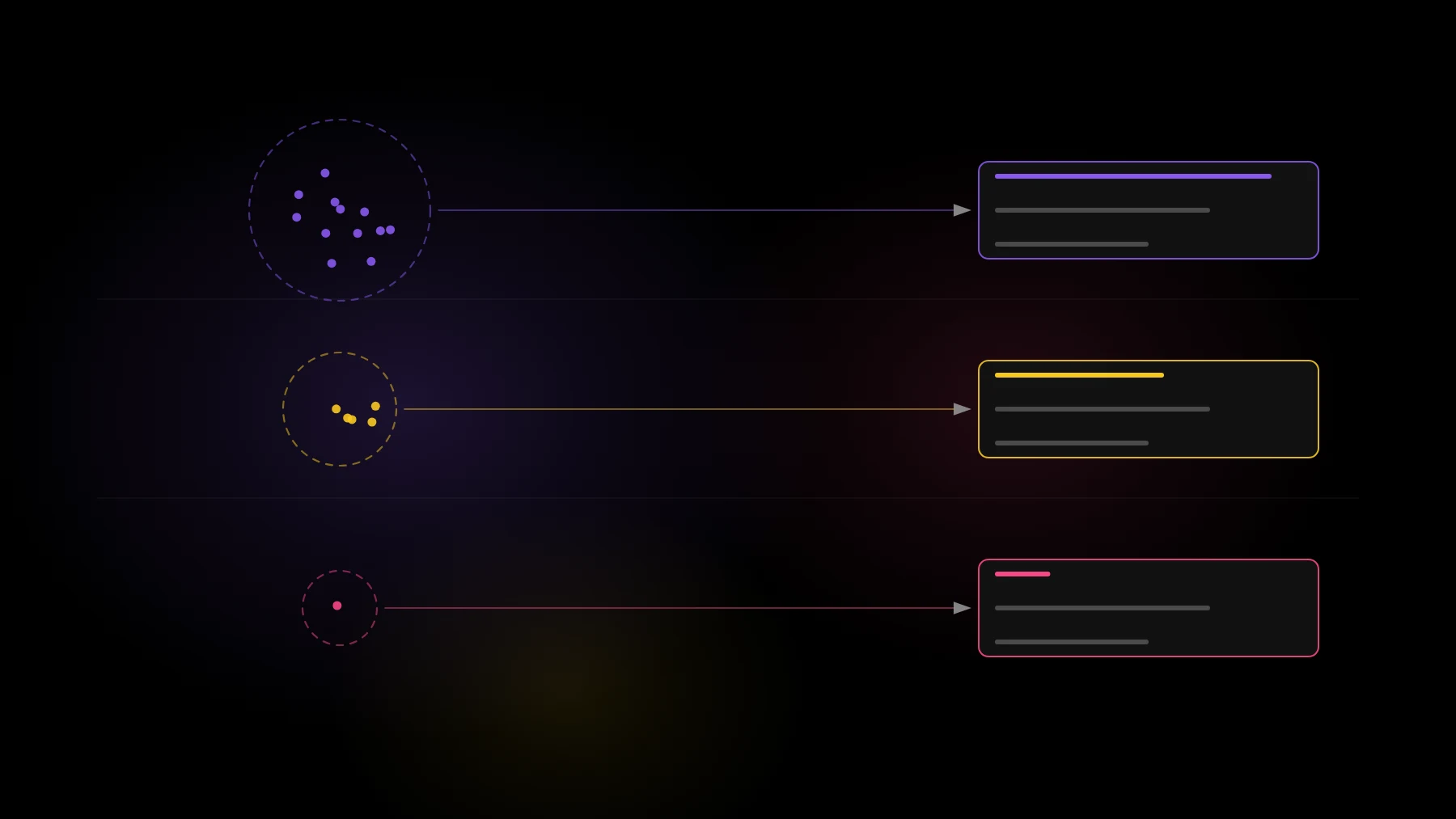
Give every hypothesis one of 3 verdicts. Agree the thresholds before you search, so nobody moves the goalposts after.
| Verdict | Accounts | Segments | Recency | Contradiction |
|---|---|---|---|---|
| 🟢 Supported | 5+ distinct accounts | Mostly the segment you named | Most in the last 90 days | Little or none |
| 🟡 Mixed | 2 to 4 accounts | Spread across segments | Older or patchy | Some, from the same segment |
| 🔴 Unsupported | 0 or 1 account | Not the segment you named | Mostly old | As much as support, or more |
The numbers are a starting point. A company with 30 customers might call 3 accounts supported. A company with 3,000 might want 20. Pick yours and write them down.
Mixed is the most useful verdict. It tells you exactly which question to ask next, and of whom.
”Mixed is the most useful verdict.”
Step 4: know when to go talk to customers anyway
Your calls are a sample of the conversations that happened to get recorded. They’re not the conversations you need.
A product leader we interviewed put it well: “there is some utility in going and talking to customers still. And so you don’t want to rely on it too much.”
Go talk to people when:
- 🆕 The segment is new. You have no calls with them yet, so silence means nothing.
- 🟡 The verdict is mixed and the split runs along a line you can’t see in the data (plan, role, region).
- 💸 The bet is big. A pricing change or a new product line deserves 5 fresh conversations, not a search.
- 🔁 Everyone said yes. If every call supports it, check you’re not only hearing from the champions who like you.
The point of the check isn’t to replace discovery. It’s to stop you from skipping it on the ideas that most need it.
Step 5: hand the agent a spec with the evidence attached
A supported hypothesis becomes a spec. Attach what you found, so the agent (and the reviewer after it) can see why this is worth building:
- 🧾 The hypothesis in its 4 lines
- 🔢 The verdict and the counts: accounts, segments, dates
- 💬 2 or 3 quotes with their source, including one that cuts against it
- 🚧 What’s out of scope, so the agent doesn’t build the adjacent thing nobody asked for
The agent builds from the spec. The reviewer checks the build against the evidence. And 3 weeks later, when someone asks “who wanted this?”, the answer is on the page.
Where Evermuse fits
You can run this check by hand with a call library and a spreadsheet. It takes an afternoon per hypothesis, which is why most teams don’t.
We built Hypotheses to make it a few minutes. It’s a restricted alpha today (since our November 3 release): you write the hypothesis, and Evermuse checks it against your customer calls, tickets and notes, with cited evidence, a verdict and a history of every run. It sits on top of our customer context layer: everything your customers said, counted and cited, in one place your team and your agents can use. Our forward-deployed builders, the engineers who set it up on your data, can turn it on for your workspace.
See it on your own data: connect Evermuse to Claude and ask it to test the next hypothesis on your roadmap.
FAQ
How do I validate a product hypothesis with customer calls? Write the hypothesis in 4 lines (we believe, for whom, we will see, in calls we expect), search your calls for support, contradiction and silence, count distinct accounts, and score it supported, mixed or unsupported against thresholds you set first.
How many customers need to mention something before it counts as supported? It depends on your size. A common starting point is 5 or more distinct accounts, mostly in the segment you named, most of them in the last 90 days, with little contradiction. Set the bar before you search.
Does checking calls replace customer interviews? No. Calls show what’s already been said. Go talk to customers when the segment is new, the verdict is mixed, the bet is big or every call agrees.