
Product agents can read your metrics. None of them have heard a customer.
Stitch Loop and Amplitude Wave go from metrics to pull requests. What metrics can't tell an agent, and a 5-line checklist before it opens PRs.

In 2 weeks the product loop closed. Google Labs launched Stitch Loop, “a long-running product agent that connects to your codebase and live metrics”, that suggests changes, builds them and reflects on the results. Amplitude shipped Wave, which compresses product improvement cycles “from weeks to 1-2 days”.
Live metrics in, pull request out. No human writes the code.
That’s a real step. It’s also missing half the evidence. The metrics say what happened. Your customers already told you why. And none of these agents were in the room.
”The metrics say what happened. Your customers already told you why.”
What a metric can tell an agent, and what it can’t
Metrics are great at the what. They’re precise, they’re live and they update without anyone writing a note. They’re silent on motive.
| Signal | What it shows | What it misses |
|---|---|---|
| 📉 Funnel drop-off | Where people leave | Why they left, and whether they meant to |
| 🖱️ Feature usage | What gets clicked | What people wanted and couldn’t find |
| ⏱️ Time on page | Where people slow down | Whether they’re confused or just reading |
| 🔁 Retention curve | Who stays | What the ones who left were trying to do |
| 🧪 A/B result | Which variant won | Whether either variant fixed the real problem |
| 🎫 Ticket volume | That something hurts | Which accounts it hurts, and what they’d pay to fix it |
An agent optimizing on the left 2 columns will get better at moving numbers. It won’t get better at knowing which numbers matter.
The why lives in 5 places nobody joins up
The reason behind a number is almost always already written down somewhere. It’s in a sales call, a support ticket, a Slack thread with a CSM, an interview a PM ran in March and a churn note in the CRM.
That’s 5 tools, owned by 4 teams, and none of them talk to each other.
A CPO on one of our sales calls described the gap exactly: “all the tools have the meeting specific summaries, but nothing that I know of is driving insights from across all these conversations.”
We hear versions of that a lot. When we searched our own customer calls from this year on this theme, it came back with 494 matching signals across 277 meetings and 48 companies. The pattern holds: each tool summarizes its own slice, and nobody counts across them.
Some teams build their way out. A product leader at an inventory software company told us they built a data lake with custom MCP servers over tickets, analytics and Slack. They asked it about 1 customer and got back, in effect, “this customer’s not happy”, with the reasons. That’s the right instinct. It’s also a system somebody now has to maintain.
What happens when an agent optimizes the wrong why
Here’s a pattern we see often enough to sketch (the numbers are made up, the shape isn’t).
Checkout conversion drops 8% after a pricing page update. A metrics-only agent sees the drop on the payment step, tests a bigger, brighter “Complete purchase” button and ships the winner. Conversion recovers 2 points. The agent logs a success.
Meanwhile, 6 sales calls that week included some version of “I wasn’t sure which plan included SSO”. The pricing page made people unsure what they were buying. They got to checkout, hesitated and left.
The button didn’t fix that. It just pushed a few more unsure buyers through, some of whom will ask for a refund. The agent fixed the symptom it could see and missed the cause it couldn’t hear.
”The agent fixed the symptom it could see and missed the cause it couldn’t hear.”
Product teams have always had this problem. The difference now is speed. A person might have caught it in a review. An agent running a loop every day won’t, unless the why is in the loop.
Give the agent ears
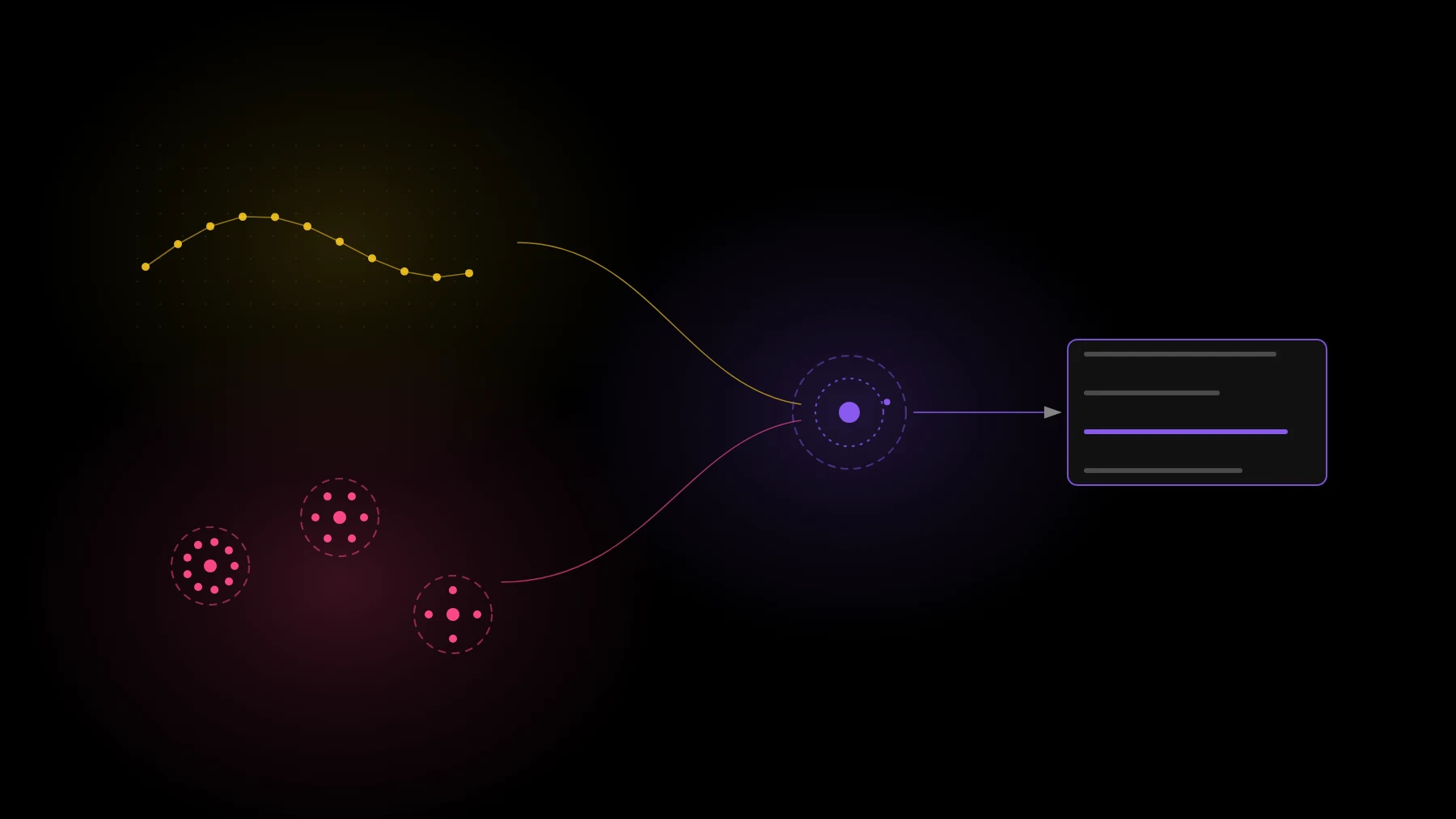
The fix isn’t to slow the agent down. It’s to give it the other half of the evidence, in the same loop, in a form it can use.
That means 3 things:
- 🔢 Counted, not summarized. Not “customers mentioned pricing” but “11 accounts raised plan confusion in the last 30 days, 4 of them on annual contracts.” Counted, cited needs (how many customers asked, what they’re worth, with the source behind every number) are something an agent can weigh against a metric.
- 🔗 Cited, every time. Each claim links to the call or ticket it came from, so the reviewer can check it in 10 seconds.
- 🧭 Next to the metrics. The agent sees the drop-off and the 11 calls in the same context, before it decides what to build.
This is what we mean by a customer context layer: everything your customers said, counted and cited, in one place your team and your agents can use. Product agents will keep getting better at reading metrics. The teams that win will be the ones whose agents can also read the customer.
A 5-line checklist before you let a product agent open PRs
Before you give any product agent write access to your codebase, check that it can answer these:
- 👂 Who asked? Can it name the accounts behind the change, not just the metric?
- 🔢 How many? Can it count distinct customers, not mentions?
- 💬 Says who? Does every claim in its plan link to a call, ticket or note you can open?
- ❌ Who disagrees? Did it look for customers who said the opposite?
- 🧑⚖️ Who signs off? Is a person reviewing the plan before the code, not only the code after?
If the answer to the first 3 is no, the agent is optimizing numbers. That might be fine for button colors. It’s not fine for your roadmap.
Where Evermuse fits
Evermuse is the customer context layer for your product agents. Our AI agents read every call, ticket and note, then turn them into counted, cited needs your agents can query over MCP, next to the metrics they already read from Amplitude or PostHog. Our forward-deployed builders (the engineers who set it up on your data) wire in the sources, usually before the next meeting.
See it on your own data: connect Evermuse to Claude and ask why your last metric moved.
FAQ
What is an AI product agent? A product agent connects to your codebase and product metrics, suggests changes, builds them and checks the results in a loop. Google’s Stitch Loop and Amplitude’s Wave are recent examples.
What can’t product analytics tell an AI agent? Why users behave the way they do. Metrics show where people drop off or what they click, but the reasons are in sales calls, support tickets, Slack threads and interviews.
How do you give a product agent customer context? Feed it counted, cited customer evidence (how many accounts raised something, which ones, with links to the source) in the same loop as its metrics, for example over MCP.