
May 2026 Release Notes: MCP Everywhere, a New Usage Page, and a Faster, Safer App
A major MCP integrations push, a new Usage page for credit transparency, a rebuilt meeting page, and a deep performance, security, and reliability pass.
TL;DR
May was a big month for integrations, performance, and hardening. Everything below is new this month. The shortlist:
- MCP everywhere: A major integrations push - an OAuth 2.1 authorization server to securely connect Claude Desktop, Cursor, and more; a marketplace of suggested servers; new Google Slides, Docs, and Figma integrations; and a new
add_sourcetool to push sources in from your AI client. - Usage page: A dedicated page that makes credit consumption transparent - track usage and read a full activity log of what drew down credits, by feature.
- Meeting page rebuild: A re-architected, faster meeting page, richer document views, and a batch of transcript and video-playback fixes.
- Faster, leaner, and more secure: Frontend bundle splitting and route-based lazy loading, a modernized dependency stack, HMAC-signed sessions, and a string of security patches.
- Reliability: The notes and call-transcription pipelines are back online, alongside a wave of Chargebee billing updates.
🔌 MCP everywhere: connect Evermuse to your AI tools
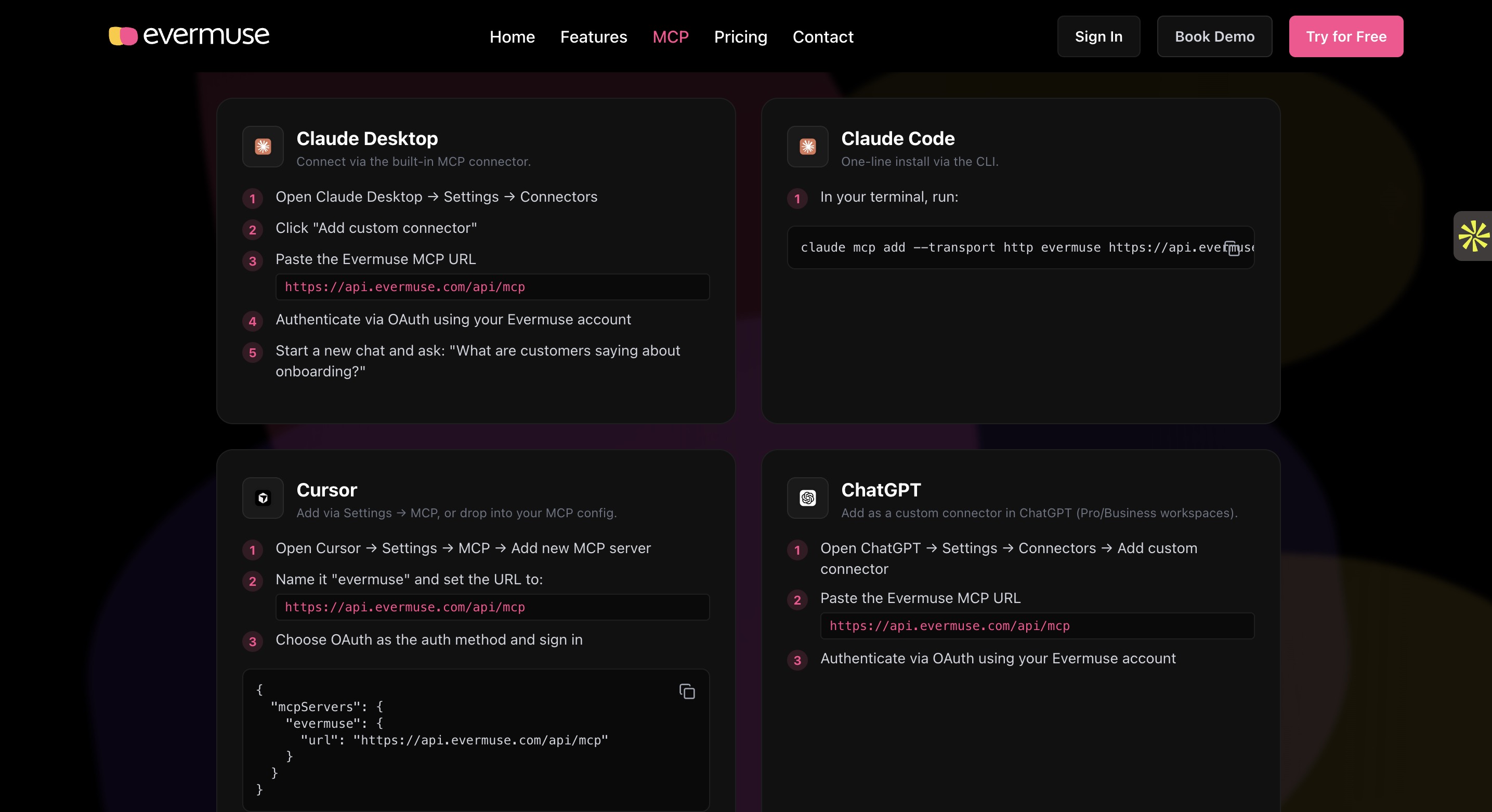
The biggest theme of the month. Evermuse is becoming a hub you can both push into and pull from, directly from the AI tools you already use. Here’s a link to our dedicated MCP landing page.
- OAuth 2.1 authorization server. A full OAuth 2.1 server with Dynamic Client Registration, so you can securely connect MCP clients like Claude Desktop and Cursor - with a consent screen that shows exactly which workspace you’re authorizing. OAuth sessions now persist your product and project selections across calls.
- A marketplace of servers. Backend readiness for an MCP marketplace, with suggested servers surfaced per workspace and the ability to toggle restricted integrations on.
- New integrations. Google Slides and Google Docs join the lineup, along with a (restricted) Figma integration.
- The
add_sourcetool. A new MCP tool that lets your AI client push a Markdown file, spreadsheet, or transcript straight into a project as evidence or context. - More reliable transport. MCP tool calls now return standard JSON, OAuth discovery is more forgiving of non-standard servers, and authenticated sessions are stickier.
📊 Usage page: credit consumption, made transparent
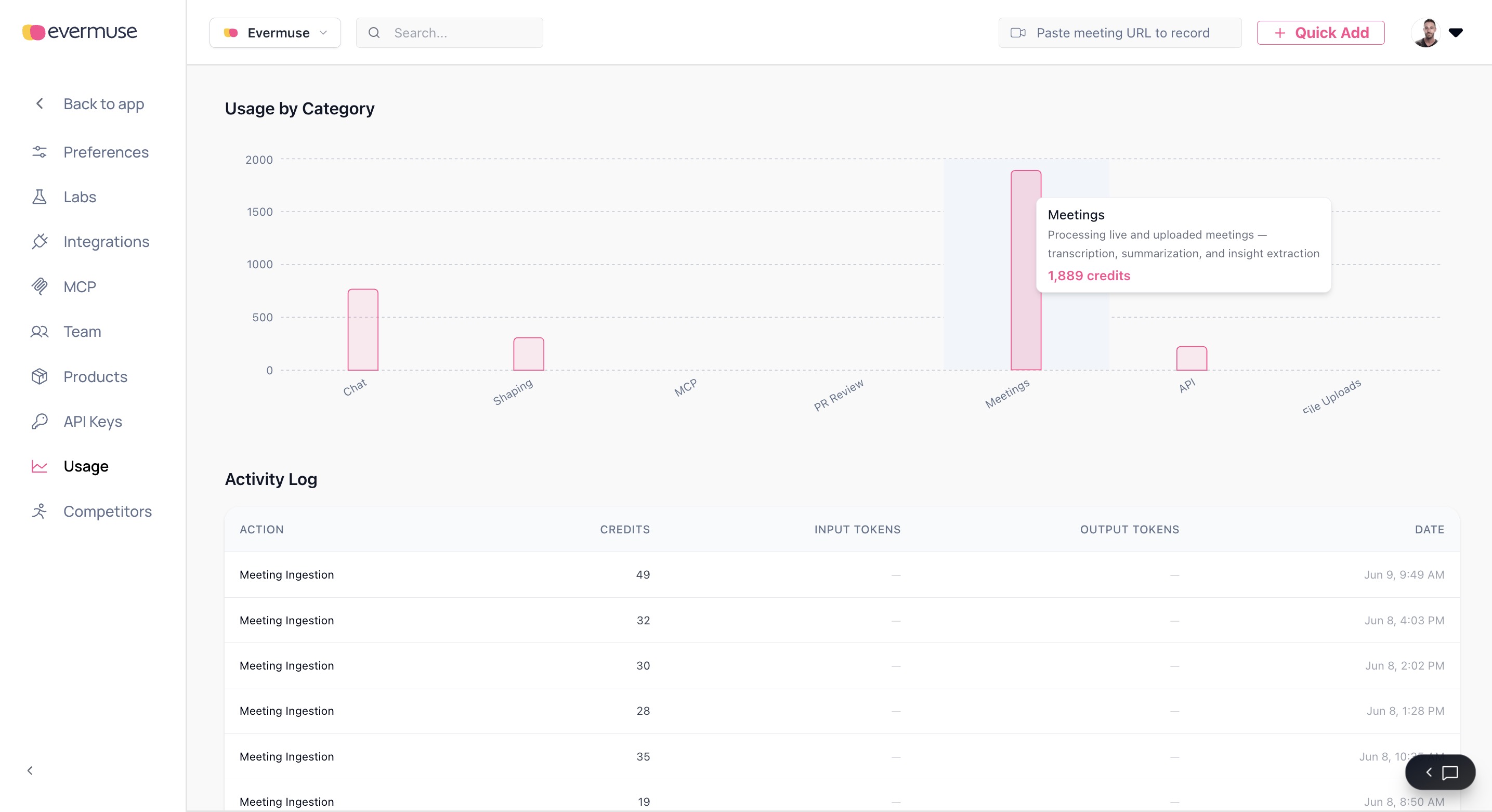
Evermuse now has a dedicated Usage page that makes credit consumption transparent. Every workspace gets a clear view of what’s drawing down credits and when - credit tracking paired with a running activity log, so usage is something you can see and reason about instead of guess at.
- Activity log. A chronological record of the actions that consumed credits, so a number on your invoice always traces back to something concrete.
- Accurate breakdown. In-app uploads are now correctly included in the usage breakdown, so the totals reconcile.
🎥 A rebuilt meeting page
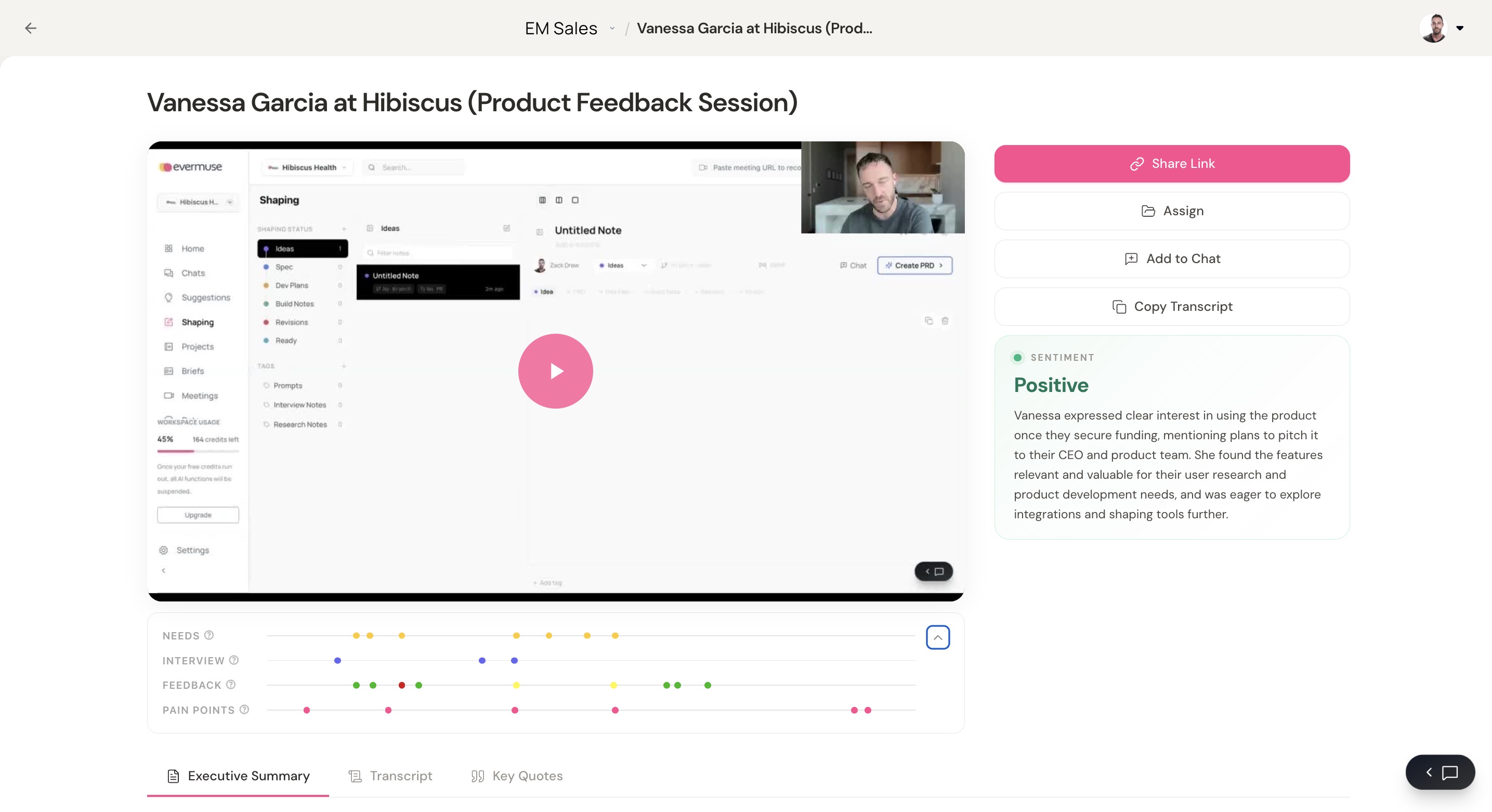
The meeting detail page was re-architected for performance and maintainability, and the document view gained skeleton loaders, a transcript card, and meeting metadata. A batch of transcript and playback fixes landed alongside it:
- Plain-text transcripts now render correctly without timestamps.
- Batch-loaded meeting signals sort by transcript time, so the timeline reads in order.
- Video playback uses a signed recording URL, so clips play reliably from chat sources and signal details.
⚡ A faster, leaner app
A major performance and modernization pass under the hood:
- Smaller initial load. Vendor code splitting, route-based lazy loading, and deferred or lazy-loaded heavy modules - the Lexical editor, the emoji picker, the file importer, video.js, and Chargebee - mean the app paints sooner.
- Fewer round-trips. Loading products no longer fires a cascade of N+1 API calls.
- A modernized stack. We swapped aging dependencies for lighter, better-maintained ones - dnd-kit for drag-and-drop, Embla for carousels, Zod for validation, and ShadCN form controls - trimming bundle weight and tech debt.
🔒 Security hardening
- Signed sessions. User identity is now carried in an HMAC-signed cookie set at login and verified on every refresh, closing a class of cookie-injection vectors.
- Tighter build output. Source maps are now hidden and an environment-variable leak was removed from the build config.
- Patched dependencies. Upgraded axios to 1.15.2 to close a prototype-pollution advisory, and resolved a set of Semgrep findings.
🔧 Reliability and billing
- Pipelines back online. The notes-generation and call-transcription pipelines had been silently disabled by commented-out functions - both are restored, with a clear error when a meeting document is missing instead of a silent skip.
- Billing updates. A wave of Chargebee fixes: every subscribed-workspace credit is now reported, overage usage is allowed for subscribed workspaces, refunds reverse usage to prevent double-billing, metering uses the correct addon IDs, and API and ingest meetings are excluded from the unbilled audit.
✨ Polish
A long list of smaller fixes that add up:
- Roadmap Suggestions now use a consistent denominator across all meeting types, with hardened tooltips.
- The Home Suggestions sub-tab stays hidden until there’s enough processed signal to be useful.
- Fixed a stale-import bug that could show an empty Projects page.
- Project state moved into a dedicated store, and a chat thread-refresh race was eliminated.
- Inline ingested records serialize to readable Markdown instead of raw JSON.
- Automatic Inngest sync after deploys, and new Firestore indexes for usage and activity queries.
For questions, feedback, or support, please reach out to the Evermuse team at team@evermuse.com - we’re here to help!